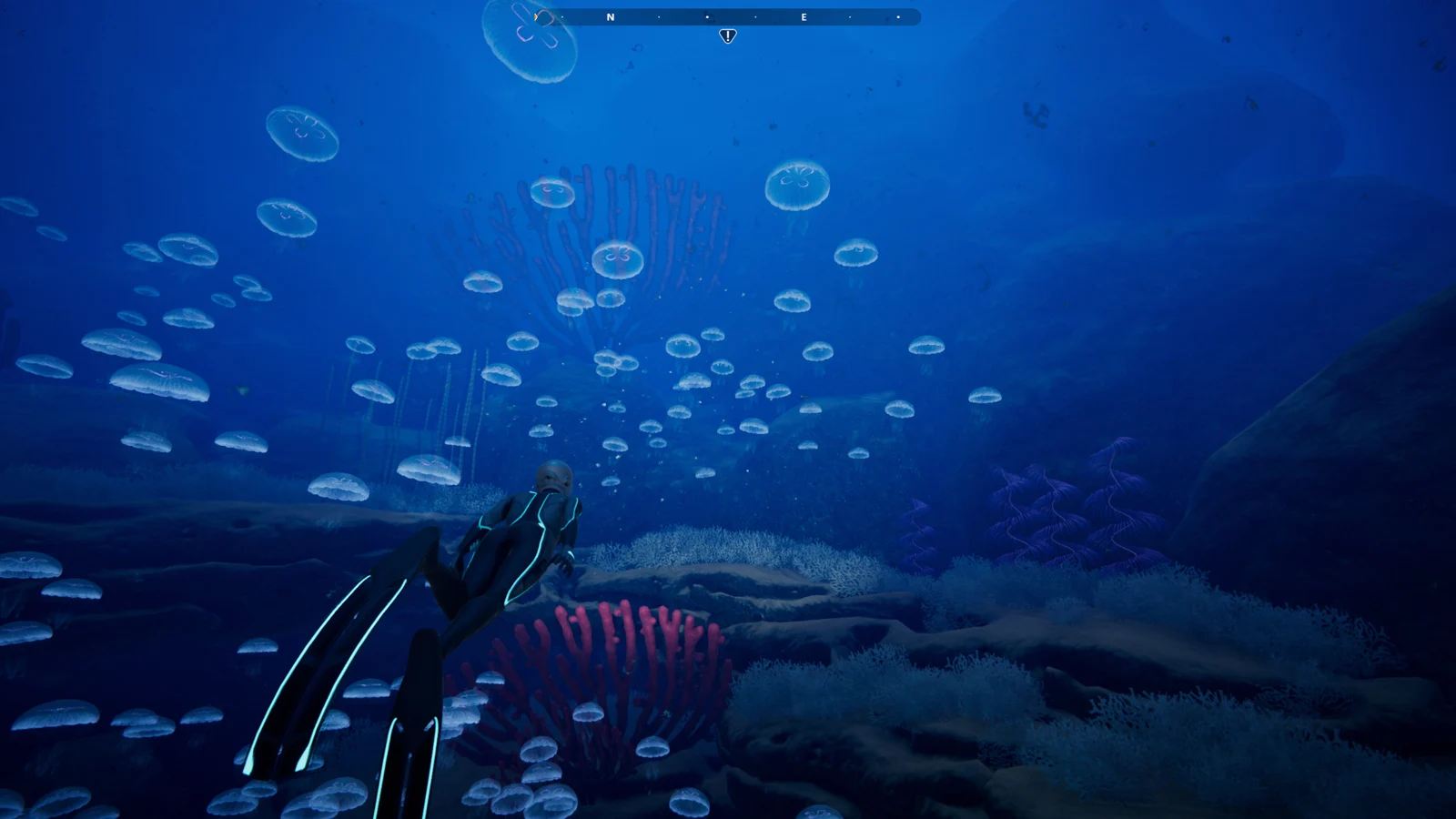
Listening belongs beside looking
Beyond Blue's story follows a research team whose tools involve seeing, hearing and interacting with the ocean. That gives an underwater diary more material than a list of animals. Begin by listening to the current scene before moving quickly towards a marker. Distinguish dialogue and task feedback from the environmental soundtrack. The purpose is not to infer a guaranteed animal location from an unverified noise; it is to recognise which sounds are actually part of the encounter you are observing.
Choose a quiet observation stop
An original listening exercise can use a recognisable rock, buoy approach or clear patch of water as its stopping place. Remain there long enough to describe the audible scene in ordinary language: a broad background wash, a distinct call or a cue associated with an interaction. Do not invent decibel measurements or a scientific explanation for the sound. A subjective listening note should say what it sounded like, while the game's own species and objective information can provide the confirmed labels.
Balance the soundtrack and the information
Use the audio controls available in your edition if dialogue or prompts are difficult to follow. Make a practical adjustment for intelligibility rather than assuming that one universal volume mix creates the most realistic ocean. A research-oriented session may prioritise spoken context; a visual visit may leave more attention for environmental sound. Both choices concern the player's presentation of the game. They do not alter the biological meaning of what is heard or establish how a real animal would respond.
Pair one sound with one image
Finish the page with a visual detail and an audible detail from the same stretch of the dive. An illustrative entry could pair the silhouette of a large animal with the remembered quality of a call, while explicitly leaving its biological interpretation unstated. This produces a richer diary than a row of names and avoids pretending that the writer carried out scientific field research. The game offers an invitation to notice; the actual observation remains a record of a virtual scene.